One supplier has submitted a detailed technical proposal. Another has shared its commercial offer in a different format. A third has missed a requirement, but the team needs to check whether it is a minor deviation or a reason for rejection. Meanwhile, procurement is waiting for engineering to complete its review, and the project team wants to know when the purchase order can move forward.
The bids are in, the evaluation is what takes time.
For EPC companies working with complex engineering packages, evaluating bids involves much more than comparing prices. Teams must check technical specifications, review compliance, identify deviations, compare commercial terms, and make sure the final recommendation can be explained and justified.
This is where AI Bid Evaluation Software can make a practical difference.
Mintmesh RUDY helps EPC teams bring bid information, engineering requirements, supplier responses, and evaluation workflows into a more connected process. Instead of spending hours collecting information and comparing documents manually, teams can focus more on reviewing exceptions and making informed decisions.
The goal is straightforward, help EPC companies complete bid evaluations 25% faster or more, without treating speed as a reason to compromise on technical checks or commercial accuracy.
Want to see how this could work for your procurement team? Book a demo of RUDY and explore a smarter approach to bid evaluation.

Why Bid Evaluation Takes Longer Than EPC Teams Expect!
A bid evaluation rarely happens in one place or through one person's work. It involves several teams, documents, decisions, and follow-ups.
The challenge is not simply the number of bids received. It is the amount of work required to turn those bids into a clear, reliable award recommendation.
1. Technical requirements are spread across documents

An engineering package may contain technical specifications, datasheets, drawings, inspection requirements, and other project documents. Suppliers respond with their own proposals, attachments, and exceptions.
Evaluators must find the relevant information in each submission and check it against the original requirements. A single missing detail can lead to another review. When several suppliers submit lengthy proposals, even locating the right information becomes a time-consuming task.
2. Comparing suppliers becomes a spreadsheet exercise
Different suppliers do not always present their offers in the same format. One may respond point by point, while another may provide a separate compliance statement or refer to a requirement in an attachment.
Evaluation teams often transfer this information into spreadsheets to create a common comparison. The challenge is that someone must read the source documents, enter the details, verify the entries, and repeat the process for every supplier. When the information changes, the comparison may need to be updated again.
The team spends valuable time preparing the comparison before it can properly evaluate the differences.
3. Small deviations create large review cycles
A supplier may propose an alternative material, exclude an inspection requirement, or leave a specification unanswered.
Each exception needs attention. The evaluator must understand what was requested, what the supplier offered, and whether the difference requires clarification or further technical review. Without a structured way to identify and track these differences, reviewers may revisit the same documents multiple times.
The real delay is not always the deviation itself. It is the time spent finding it, understanding it, assigning it to the right person, and recording the final decision.
4. Technical and commercial evaluations do not always move together

Engineering may be reviewing compliance while procurement is checking prices, delivery terms, payment conditions, and other commercial details. If these activities are managed in separate files or disconnected workflows, procurement may have to wait for updates before it can prepare a consolidated view.
A technically attractive offer may not be commercially competitive. Similarly, the lowest-priced offer may have unresolved technical exceptions. The team needs both perspectives before it can make a sound recommendation.
5. The reasoning behind a decision is difficult to reconstruct
An evaluation is not complete just because a preferred supplier has been identified. The team must also be able to explain why the supplier was selected.
Reviewers may need to revisit comments, clarification emails, spreadsheet changes, and earlier versions of the bid comparison. This becomes especially difficult when several people have worked on the evaluation. When the supporting information is scattered, preparing the final recommendation takes longer than it should.
EPC bid evaluation needs more than faster document reading. It needs a better way to connect requirements, supplier responses, exceptions, reviews, and decisions.
How RUDY Helps EPC Companies Complete Bid Evaluation 25% Faster?
Mintmesh RUDY is an AI-powered Source-to-Contract platform built for capital projects. It connects sourcing, supplier collaboration, bid evaluation, and award-related workflows. Its value in bid evaluation comes from reducing the repetitive work that sits between receiving supplier offers and deciding.
1. Move from document hunting to requirement-led evaluation
Instead of treating every supplier submission as a separate collection of documents, teams need a consistent view of what was requested and how each supplier responded.
RUDY's AI-driven document intelligence and Engineering Language Processing capabilities help teams work with engineering documents and identify relevant information for evaluation.
This can reduce the effort involved in searching through lengthy proposals and manually gathering responses against requirements.
Evaluators can then spend more time examining important differences rather than repeatedly locating the same information.
Impact: Less time spent preparing the evaluation and more time available for technical review.
2. Make supplier comparisons easier to review
A useful bid comparison should help an evaluator answer three questions:
- What did we ask the supplier to provide?
- What has the supplier actually offered?
- Where does the offer differ from the requirement?
RUDY supports AI-assisted bid evaluation by helping teams structure and compare supplier information against engineering requirements.
This creates a more consistent starting point for reviewing supplier offers. Instead of manually building every comparison from scratch, the team can focus on the information that needs attention.
Impact: Reduced repetitive comparison work and a clearer view of differences across supplier submissions.
3. Identify exceptions before they become late-stage surprises
Not every deviation has the same impact on a project.
A missing document may require a clarification. An alternative technical solution may need engineering approval. A commercial exception may affect the overall value of the offer.
RUDY helps bring compliance gaps and deviations into the evaluation process so reviewers can examine the relevant differences and determine the appropriate next steps.
The purpose is not to let AI make every decision automatically. It is to help evaluators find issues earlier and direct their attention where human judgement matters most.
Impact: Fewer avoidable review loops and less time lost discovering unresolved issues late in the evaluation.
4. Connect procurement and engineering around the same evaluation
When engineering and procurement work from disconnected records, even a straightforward question can take several follow-ups to resolve.
RUDY connects bid evaluation with the broader sourcing workflow, giving teams a more structured way to manage evaluation activities and move towards an award recommendation.
With better visibility into outstanding reviews, clarifications, and deviations, teams can identify what is holding up progress instead of repeatedly asking for status updates.
Impact: Better coordination between technical and commercial reviewers, with fewer delays caused by disconnected work.
5. Make the final recommendation easier to support
The final decision needs to reflect more than a price comparison. It must take account of the relevant technical findings, commercial differences, and outstanding exceptions.
RUDY supports more structured, traceable evaluation workflows, helping teams maintain a clearer connection between the evaluation process and the resulting recommendation.
This makes it easier for stakeholders to understand the basis of a decision and review the information supporting it.
Impact: Less effort spent bringing scattered evaluation records together when preparing the award recommendation.
Where Does the 25% Time Saving Come From?
A 25% faster evaluation cycle does not have to mean that every engineer works 25% faster or that every bid is evaluated in the same amount of time.
The improvement can come from reducing avoidable work across the entire process.
Consider a hypothetical EPC evaluation that normally takes 20 working days from the start of evaluation to the completed recommendation.
Evaluation activity - What creates delays - How RUDY can help?
- Document review - Searching through lengthy supplier submissions - AI-assisted document intelligence
- Requirement comparison - Manually matching responses to specifications - Structured, requirement-led evaluation
- Deviation review - Finding and tracking exceptions across files - Better visibility into compliance gaps and deviations
- Team coordination - Following up on pending technical and commercial reviews - Connected sourcing and evaluation workflows
- Award preparation - Consolidating comments and supporting information - More structured and traceable evaluation records
- Collaboration Capability - Both internal and external team interact- Communicating within the portal itself.
The objective is to remove repeated work from each stage rather than depend on one major improvement.
An illustrative 25% faster evaluation
Suppose an EPC team takes 20 working days to complete an evaluation.
>> Current process might take 20 working days
>> Target reduction is 25%, or 5 working days
>> Target evaluation time would be 15 working days
That is five working days returned to the project schedule for this example.
The calculation is simple:
Time saved = Original evaluation time × Percentage reduction
For a 20-day baseline, a 25% reduction equals five days.
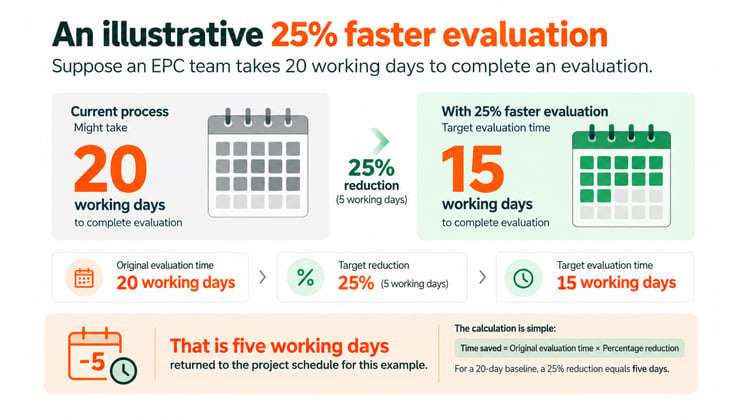
This example illustrates the target, it is not a measured RUDY customer result. Actual savings will depend on the number and complexity of bids, the quality of supplier submissions, existing workflows, and how the platform is implemented.
For an EPC company handling multiple procurement packages, even a modest improvement in individual evaluation cycles can make a meaningful difference to procurement planning.
Why AI Bid Evaluation Software Matters for Complex EPC Projects?
In EPC procurement, a delayed evaluation can affect more than the procurement team's internal schedule. It can influence equipment availability, package award dates, supplier commitments, and downstream project activities.
This makes the choice of evaluation software a business decision, not simply a technology upgrade.
Faster evaluation without skipping technical checks
The objective is to reduce the effort required to find, organise, and compare information, not to remove the checks that protect project quality.
AI can assist with information extraction and identifying potential deviations. Qualified reviewers must still assess critical exceptions, validate findings, and approve decisions according to the project's requirements.
A more consistent evaluation process
When different evaluators use different spreadsheets, templates, and review methods, comparisons can become difficult to standardise.
A structured platform can help establish a more consistent approach to evaluating supplier responses, while retaining the review and approval steps required by the organisation.
Better visibility for procurement leaders
Procurement leaders need to know whether an evaluation is progressing, which reviews remain open, and what is preventing the award recommendation from moving forward.
Connected workflows can help teams identify these bottlenecks earlier and make more informed decisions about where to focus their efforts.
A stronger foundation for sourcing decisions
Bid evaluation is one stage in the larger Source-to-Contract process. Its output should support the next decision, rather than create another disconnected set of records.
By connecting sourcing and evaluation workflows, RUDY helps EPC teams work towards a more joined-up process from supplier offers to award.
Is RUDY the Right AI Bid Evaluation Software for Your EPC Company?
RUDY is worth exploring if your procurement team faces challenges such as:
- Evaluating lengthy technical proposals against detailed engineering specifications.
- Comparing supplier offers submitted in different formats.
- Spending too much time creating and maintaining bid comparison spreadsheets.
- Repeating technical reviews because exceptions or clarifications are difficult to track.
- Coordinating engineering, procurement, and commercial stakeholders across separate workflows.
- Preparing award recommendations from information stored across multiple documents and records.
- During Collaboration, where team faces or manages internal or external collaboration via email or excel.
If these problems sound familiar, the next step is to examine how your current evaluation process works and where time is being lost.
A useful assessment starts with your existing baseline: how long evaluations take, which activities consume the most effort, how often reviews are repeated, and where approvals get delayed.
From there, your team can explore how RUDY's capabilities fit the process and define measurable improvement targets.
Why Choose Mintmesh RUDY for Bid Evaluation?
Mintmesh RUDY is designed for capital-intensive projects where procurement decisions depend on detailed engineering requirements, supplier information, and coordination across multiple stakeholders.
Rather than approaching bid evaluation as an isolated spreadsheet task, RUDY connects it with the wider Source-to-Contract workflow.
Its AI-driven document intelligence, Engineering Language Processing, deviation identification, and structured evaluation workflows help teams work with complex supplier information more efficiently.
For EPC companies, the opportunity is to spend less time assembling evaluation data and more time understanding supplier differences, resolving important exceptions, and moving towards a well-supported award decision.
The right question is not simply whether AI can read a bid faster. It is whether your organisation can move from receiving bids to making a reliable sourcing decision with less avoidable effort.
That is the improvement worth evaluating.
Ready to See How RUDY Fits Your Bid Evaluation Process?
Book a demo to see RUDY in action.
Discuss your current evaluation workflow, identify where time is being lost, and explore how AI Bid Evaluation Software could help your EPC team work towards a 25% faster evaluation cycle.